Table Of Content
It’s also possible to use a mixed methods design that integrates aspects of both approaches. By combining qualitative and quantitative insights, you can gain a more complete picture of the problem you’re studying and strengthen the credibility of your conclusions. Using valid and reliable data collection methods is important to ensure that the data collected is accurate and can be used to answer the research question. Researchers should choose methods that are appropriate for the study and that can be administered consistently and systematically. Case study research is a type of descriptive research that focuses on a single individual, group, or event. It involves collecting detailed information on the subject through a variety of methods, including interviews, observations, and examination of documents.
Why Use Voxco for Descriptive Research Design?
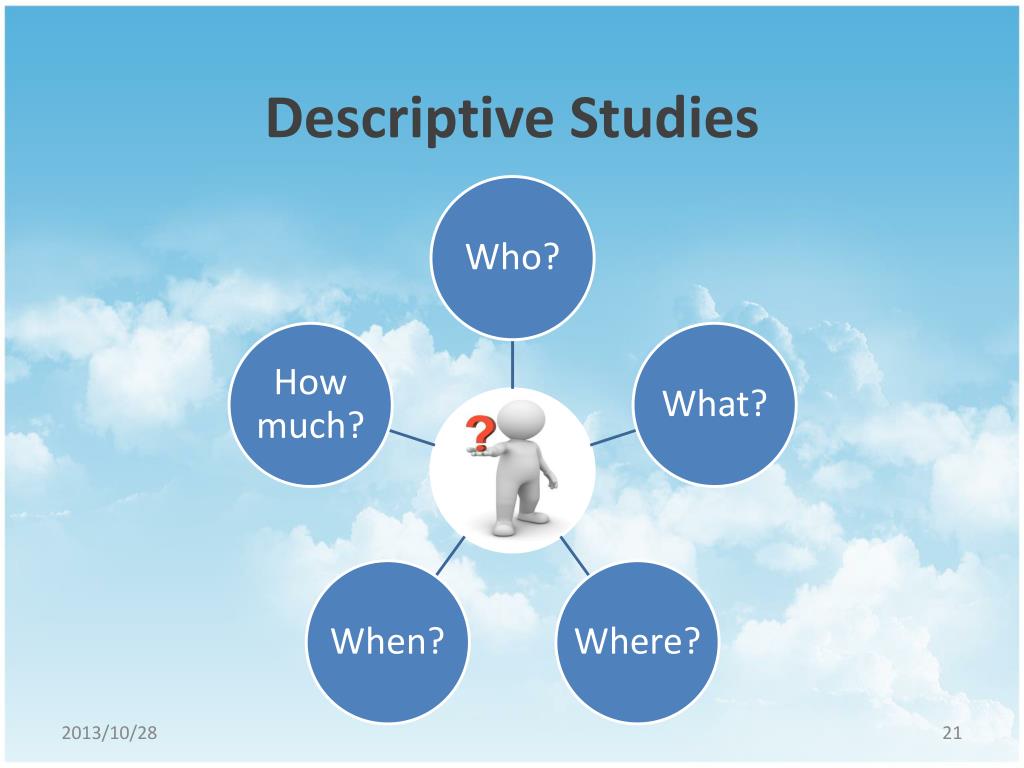
One of the most prominent characteristics of descriptive research is that, unlike in experimental research, the variables are not controlled or manipulated. Descriptive research involves the collection of quantifiable and systematic data that can be used for the statistical analysis of the research problem. However, before identifying why a phenomenon occurred, it is integral to answer other questions first. You need to have answers to the “what,” “when,” “how,” and “where” before you can understand the “why.” This is where descriptive research comes in.
Data Collection and Data Sources
A descriptive research study is a type of observational research and is used for exploring and documenting the nature and scope of a problem, identifying its trends and patterns, and providing a basis for subsequent research. The outcome of a descriptive study is helpful in making decisions, developing policies, and planning social programs. Overall, Voxco survey software is an effective tool for conducting descriptive research design, as it provides a streamlined and efficient way to gather, measure, and analyze survey data.
What is descriptive research design?
However, we will be restricting ourselves to only 3 distinct examples in this article. Correlative surveys are used to determine whether the relationship between 2 variables is positive, negative, or neutral. That is, if 2 variables say X and Y are directly proportional, inversely proportional or are not related to each other.
Descriptive Data on Region XI Head Start Children and Families: AIAN FACES Spring 2020 Data Tables and Study ... - The Administration for Children and Families
Descriptive Data on Region XI Head Start Children and Families: AIAN FACES Spring 2020 Data Tables and Study ....
Posted: Thu, 02 Dec 2021 08:00:00 GMT [source]
The observational method allows researchers to collect data based on their view of the behaviour and characteristics of the respondent, with the respondents themselves not directly having an input. It is often used in market research, psychology, and some other social science research to understand human behaviour. Initially, although the year 2014 was specifically requested, 95 articles wereidentified (due to ahead of print/Epub) and exported into the EndNote program. Threeduplicate publications were removed and the 20 articles with final publication dates of2015 were also excluded. The remaining 72 articles were then screened by examining titles,abstracts, and full-texts. Based on our inclusion criteria, 15 (of 72) were then excludedbecause QD or QD design/study was not identified in the main text.
Methods
It allows the researcher to study and describe the distribution of one or more variables, without regard to any causal or other hypotheses. This article discusses the subtypes of descriptive study design, and their strengths and limitations. Researchers can conduct various investigations and collect multiple types of data (quantitative and qualitative) using surveys with diverse designs. Descriptive design is referred to in the literature by other labels including generic, general, basic, traditional, interpretive, and pragmatic. Descriptive design as an acceptable research design for dissertation and other robust scholarly research has received varying degrees of acceptance within the academic community.
The information gathered through descriptive research can serve as a baseline for future research and provide a foundation for further studies. Let us look at a study that was aimed to assess the prevalence of myopia among Indian children.[7] In this study, trained health workers visited schools in Delhi and tested visual acuity in all children studying in classes 1–9. Of the 9884 children screened, 1297 (13.1%) had myopia (defined as spherical refractive error of −0.50 diopters (D) or worse in either or both eyes), and the mean myopic error was −1.86 ± 1.4 D.
In the subsequent sections, we will be explaining what descriptive research means, its types, examples, and data collection methods. A key component of the descriptive research method is that it uses random variables that are not controlled by the researchers. This is because descriptive research aims to understand the natural behavior of the research subject. For example you could use descriptive research to understand fashion trends in a given city when planning your clothing collection for the year. Using descriptive research you can conduct in depth analysis on the demographic makeup of your target area and use the data analysis to establish buying patterns.
What is Descriptive Research? Definition, Methods, Types and Examples
(PDF) A DESCRIPTIVE STUDY TO ASSESS THE KNOWLEDGE REGARDING IDENTIFICATION AND PREVENTION ... - ResearchGate
(PDF) A DESCRIPTIVE STUDY TO ASSESS THE KNOWLEDGE REGARDING IDENTIFICATION AND PREVENTION ....
Posted: Fri, 06 Oct 2023 02:15:18 GMT [source]
One example found in our review is that Adams et al. (2014) explored family members’ responses to nursingcommunication strategies for patients in intensive care units (ICUs). In this study,researchers conducted interviews with family members, observed interactions betweenhealthcare providers, patients, and family members in ICUs, attended ICU rounds and familymeetings, and took field notes about their observations and reflections. Accordingly, thevariability in methods provided Adams and colleagues(2014) with many different aspects of data that were then used to complementparticipants’ interviews (i.e., data triangulation). The findings showed patients’ socioeconomic constraints were important challenges that influence health professionals’ engagement, and provision of MDR-TB prevention and management services.
It aims to provide an accurate and objective representation of the subject of study. Causal research, on the other hand, seeks to determine cause-and-effect relationships between variables. It aims to point out the factors that influence or cause a particular result or behavior. Causal research involves manipulating variables, controlling conditions or a subgroup, and observing the resulting effects. The primary objective of causal research is to establish a cause-effect relationship and provide insights into why certain phenomena happen the way they do.

Selecting a representative sample is important to ensure that the findings of the study are generalizable to the population being studied. Researchers should use a sampling method that provides a random and representative sample of the population. Descriptive research is non-experimental, meaning that the researcher does not manipulate variables or control conditions. The researcher simply observes and collects data on the population or phenomenon being studied. Descriptive research studies a particular population or sample that is representative of the larger population being studied. Furthermore, sampling methods can include convenience, stratified, or random sampling.
This approach entails carefully examining a particular group, person, or event over time. You can learn something new about the study topic by using a small group to better understand the dynamics of the entire group. It enables researchers to precisely and methodically describe a population, circumstance, or phenomenon. To conduct effective research, you need to know a scenario’s or target population’s who, what, and where. Obtaining enough knowledge about the research topic is an important component of research. The main goal is to observe and catalog all the variables and conditions that affect the phenomenon.
For example, if you are researching the opinions of students in your university, you could survey a sample of 100 students. You should anonymise and safeguard any sensitive data, and make sure it’s backed up regularly. As well as choosing an appropriate sampling method, you need a concrete plan for how you’ll actually contact and recruit your selected sample. Using secondary data can expand the scope of your research, as you may be able to access much larger and more varied samples than you could collect yourself. There are many other ways you might collect data depending on your field and topic. The more precisely you define your population, the easier it will be to gather a representative sample.
Accordingly, participants encountered numerous gaps that restricted their interactions with TB/MDR-TB patients. As to our knowledge, patients’ perceived fear of discrimination was not documented whether it had direct negative impact on reducing providers’ engagement. Therefore, patients’ awareness creation is an important responsibility that needs to be addressed by the community health development army, health extension workers, all other healthcare providers and stakeholder for better MDR-TB services and patient outcomes.




No comments:
Post a Comment